Stop the slow, polite collapse of communication.
How leaders and teams move information through an organization without distortion, silence, or loss. Anchored by Failure to Communicate and the Silent Spiral™ / Breaking the Spiral™ frameworks.


How leaders and teams move information through an organization without distortion, silence, or loss. Anchored by Failure to Communicate and the Silent Spiral™ / Breaking the Spiral™ frameworks.
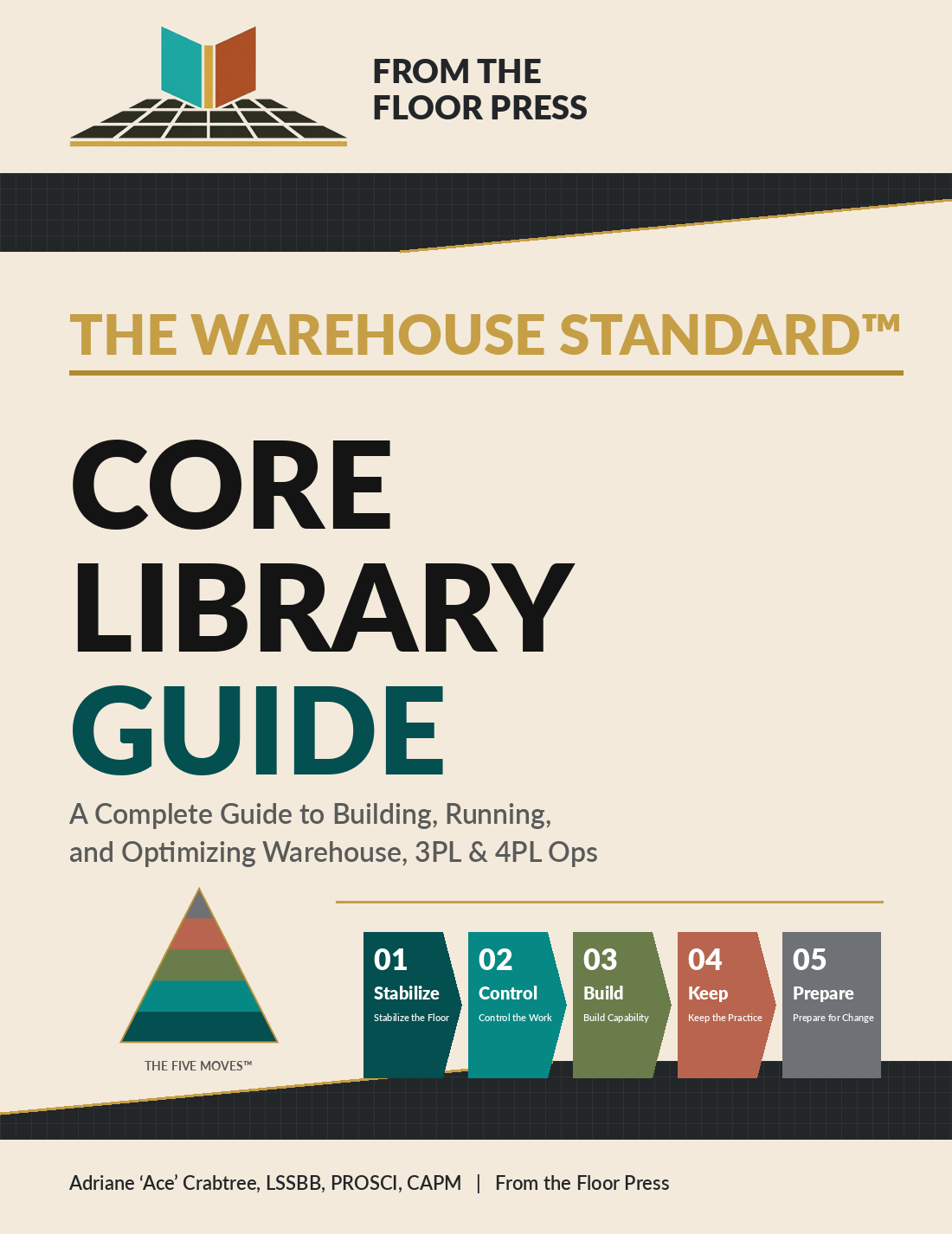
The Warehouse Standard™ — a complete library for building, running, and optimizing Warehouse, 3PL & 4PL Ops. Organized around The Five Moves™: Stabilize, Control, Build, Keep, Prepare.
of project failures trace back to one thing.
It isn't strategy. It isn't talent. It's communication — and it's fixable.
Failure to Communicate is live on Amazon and Barnes & Noble. The Warehouse Standard™: The Playbook Kindle edition is on Amazon. Core Library Guide is the free PDF you can read tonight. Paperback Playbook and the five Move companion books are rolling out through Q4 2026. The Five Moves™ carry the running color order across every cover, page, and chart.
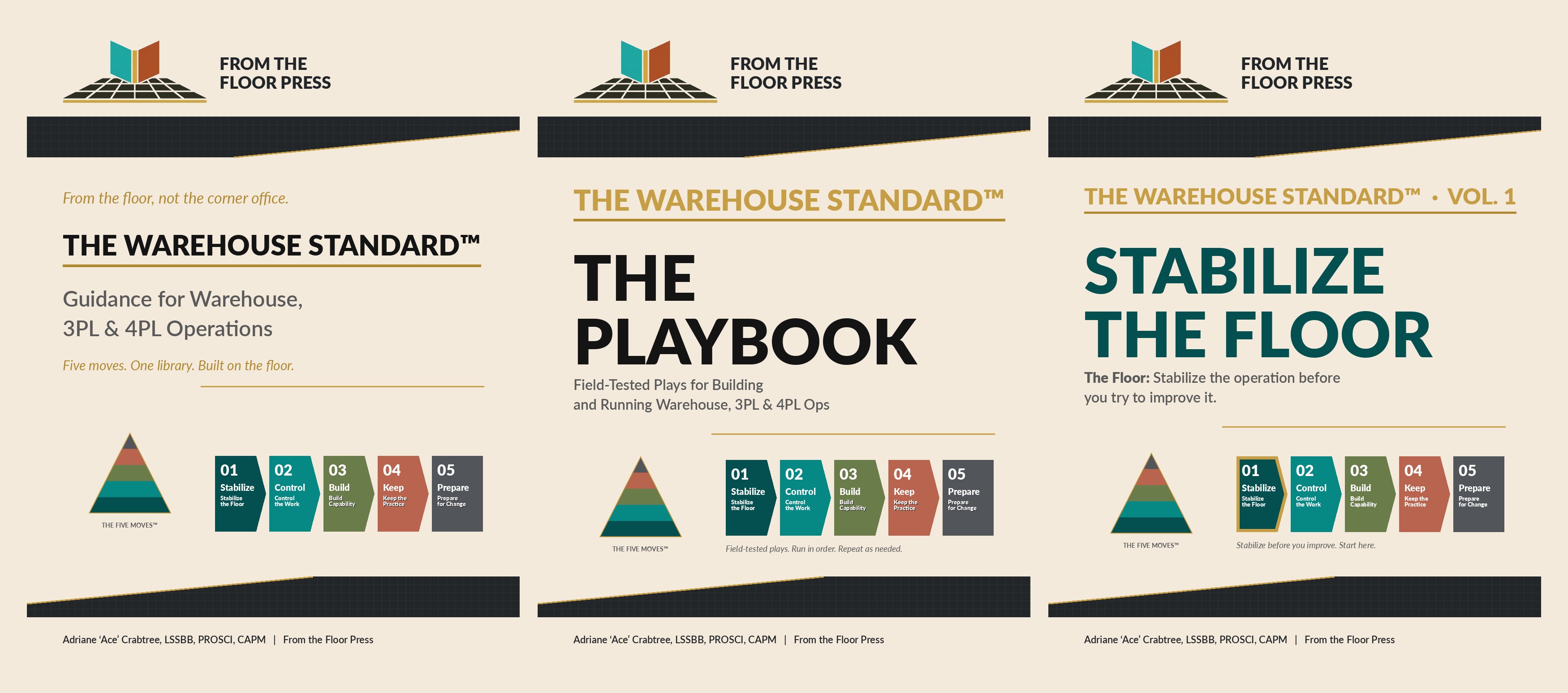
One is the book that's live on Amazon and Barnes & Noble today. The other is the free PDF that opens the door to the full operations library. Pick the one closer to the problem on your floor.
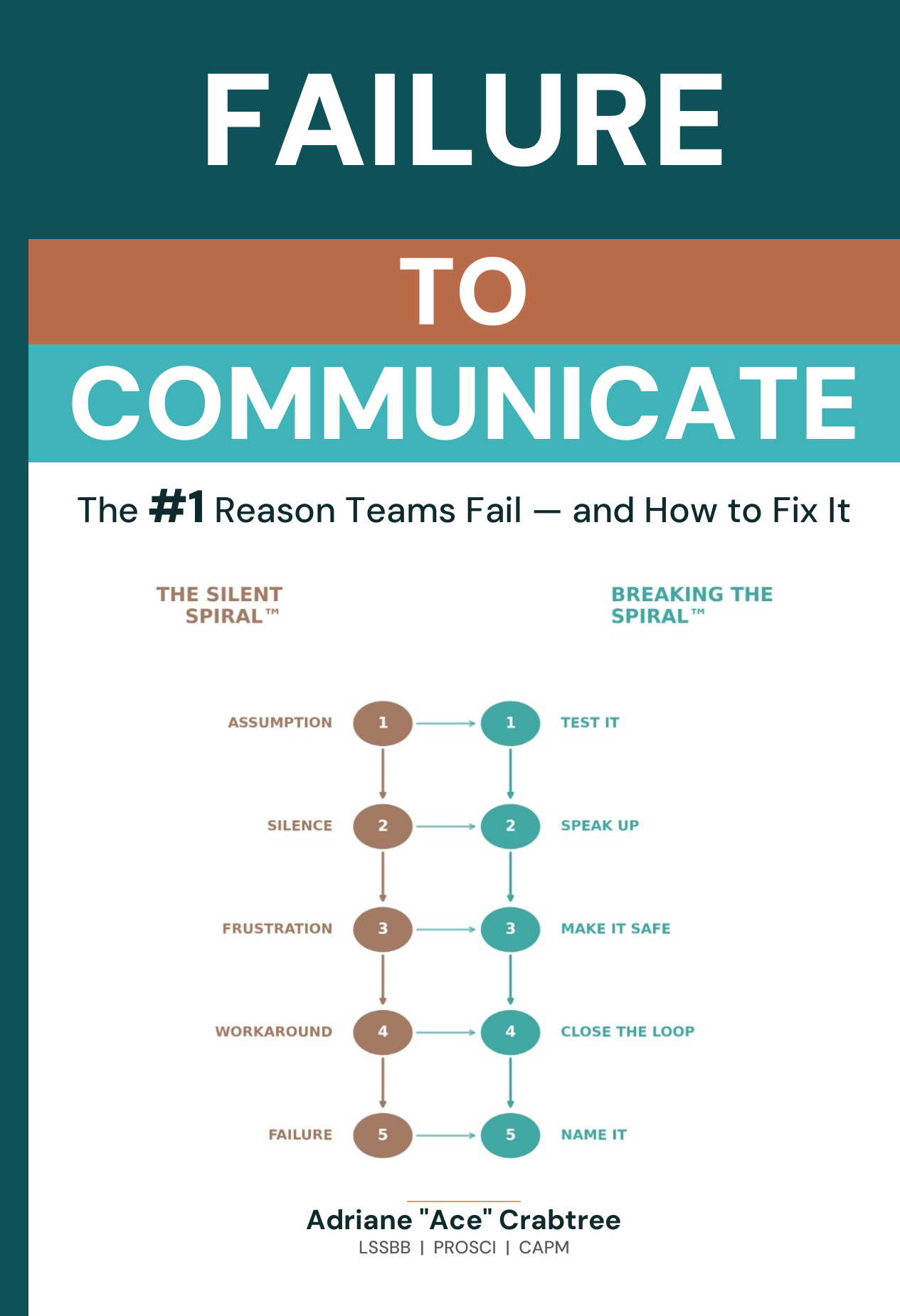
The #1 reason teams fail — and how to fix it. Names the Silent Spiral™ and gives leaders the Breaking the Spiral™ playbook to repair trust, restore alignment, and end the slow, polite collapse of communication. Amazon Top New Release in Distribution & Warehouse Management.
The free, 12-page front door to the whole operations library. Names The Five Moves™ — Stabilize, Control, Build, Keep, Prepare — and shows how the full library fits together. Written for someone meeting the work for the first time.
Every framework is built, tested, and refined inside live operations. No academic filler. The people closest to the work usually know what's broken — we publish what they've been writing on the back of receiving sheets for years.
Every book, workshop, worksheet set, and toolkit — organized by domain. On the shelf today, in the press, or in the works.
Built for distributed, shift-based, high-stakes teams.
The #1 Reason Teams Fail — and How to Fix It
The flagship work for the domain. Introduces the Silent Spiral™ and the Breaking the Spiral™ playbook. Amazon Top New Release in Distribution & Warehouse Management. ISBN 979-8-9956659-0-8.
How to Build Trust, Clarity, and Accountability Before the Spiral Begins
The prevention-side companion to Failure to Communicate. Where the first book diagnoses the breakdown, this one shows how to build a team culture where the Silent Spiral never gets started.
In editing.A Workshop Program from From the Floor Press
The Silent Spiral™ and Breaking the Spiral™ frameworks translated into a working session — built for leadership teams who need the language, not just the diagnosis. Scoped to the floor, the shift pattern, and the systems already in place.
An examination of fear as an organizational operating system
How fear forms inside a team, what it costs the operation, and what it takes to dismantle. Committed in the imprint plan.
A Small-Group Activity Book for Sharper Thinking and Stronger Teams
A publication — not a workshop. Designed for small groups, supervisors, and team leads to run their own short, hands-on sessions on judgment, communication, and decision-making.
Under The Warehouse Standard™.
A Complete Guide to Building, Running, and Optimizing Warehouse, 3PL & 4PL Ops
The front door to the whole library. Introduces The Warehouse Standard™, names The Five Moves™, and shows how the Playbook and five Move books fit together. Written for someone meeting the work for the first time.
ISBN 979-8-9956659-1-5 (digital) · assigned at Bowker.Field-Tested Plays for Building and Running Warehouse, 3PL & 4PL Ops
The front-door field guide. Opens with Set the Context — The Operating Model, followed by five sections labeled Move 1 through Move 5. Organized by the question an operations leader is actually asking, built around The Five Moves™ on the floor.
Kindle eBook · ISBN 979-8-9956659-2-2The Five-Book Deep Library — one book per Move
The long-form depth behind the front door. One book per Move: Move 1 Stabilize the Floor, Move 2 Control the Work, Move 3 Build Capability, Move 4 Keep the Practice, Move 5 Prepare for Change.
Sequenced release rolling out through Q4 2026.The Hands-On Companion to The Playbook Series™
Workbook extracts, templates, scorecards, and activation tools. Built for site directors, supervisors, and QA/IC leads to apply the work to their own operation, read where the site stands, and sequence the next work. Turns reading into reps.
Drafted; in revision.Twelve standalone toolkits · ordered by The Five Moves™
Practical templates, checklists, logs, trackers, and control tools for broad operating problems. Twelve Toolkit Sets, numbered in Move order — Toolkit 1 through Toolkit 12 — each anchored to the move it carries. Each toolkit ships ready to run.
Twelve Toolkit Sets in build; numbered T1–T12 in Move order.Downloadable Field Tools — the low-commitment entry point
Small, focused, printable downloads built around one operating problem at a time. Each set captures evidence, guides a decision, and prevents a downstream failure. Lead set: the Inbound Receiving & Inventory Control Worksheets, controlling the dock door where errors enter the building.
First set built and in revision; five more in drafting.Every book, workshop, and toolkit in the imprint runs on the same engine. These are the named, teachable, transferable frameworks that work the same way on the floor as they do on the page.
Assumption → Silence → Frustration → Workaround → Failure
Home: Failure to Communicate · Domain 01
Test the Assumption → Break the Silence → Make It Safe → Close the Loop → Name It
Home: Failure to Communicate & Workshop · Domain 01
Discovery · System Truth Table · SOP Gap Analysis · Three-Gate Readiness · Three-Proof Test
Home: The Warehouse Standard Move 5 · Domain 02
Detect → Tag → Triage → Resolve → Close the Loop → Improve (Five-Lane Triage)
Home: Issue Resolution / Inventory Control · Domain 02
Inbound · Putaway · Slot · Pick · Pack · Ship · Returns — one operating picture
Home: The Warehouse Standard Move 1 · Domain 02
Controllable · Non-controllable · Cross-functional issue routing
Home: Playbook Ch. 8 / Move 3 · Domain 02
Stabilize the Floor → Control the Work → Build Capability → Keep the Practice → Prepare for Change
Home: The Warehouse Standard™ · Domain 02
The required discipline for every SOP/WI before it's treated as live standard work
Home: Documentation Standard (Move 2) · Domain 02
The toolkit lane under the umbrella — 12 problem-first toolkits, each paired to a book of The Warehouse Standard
Home: Toolkit Library · Domain 02
All information counts as data — metrics, observations, conversations, tribal knowledge, Gemba findings
Home: Future standalone / CI materials
How leaders and teams move information through an organization without distortion, silence, or loss — anchored by Failure to Communicate and the Silent Spiral™ / Breaking the Spiral™ framework pair.
Act 01 · The Book
The flagship work — what it is, what shifts after you read it, and a free first chapter to walk in with.
The #1 Reason Teams Fail — and How to Fix It
56% of project failures trace back to one thing. It isn't strategy. It isn't talent. It's communication — and it's fixable.
This book names the Silent Spiral™ — five predictable stages of communication breakdown — and gives leaders the Breaking the Spiral™ playbook to interrupt every one of them.

Recognize the Silent Spiral™ — Assumption, Silence, Frustration, Workaround, Failure — and identify exactly which stage your team is in right now.
Apply the matching Breaking the Spiral™ intervention at every stage — Test the Assumption, Break the Silence, Make It Safe, Close the Loop, Name It.
Walk into Monday's meeting with language that surfaces understanding instead of nodding agreement — and a system that holds when you're not in the room.
A first look at the Silent Spiral™ in action.
There is a particular kind of meeting most people recognize: everyone's in the room, the agenda exists, notes are taken, action items assigned. Three weeks later, nothing has moved — or things have moved in exactly the wrong direction, with everyone believing they were following the plan.
That meeting is the visible surface. What you don't see is the fault line running beneath it.
Communication breakdown almost never announces itself. It creeps in through a meeting invite with no context, a SharePoint message someone forgot to answer, a hallway decision that never made it back to the team. By the time the failure becomes visible, the accumulation is months deep.
I've watched this happen in hospitals, for-profit education systems, government agencies, and warehouses the size of multiple football fields. Industry doesn't matter. Headcount doesn't matter. The failure mode is startlingly consistent. I call it The Silent Spiral™ — five predictable stages, each one making the next harder to escape.
A morning shift supervisor heard from the previous shift that "the new pick rate target is 140." She told her team leads: "Target is 140 — push for it." By the third huddle of the day, that had become "if you don't hit 140, there'll be consequences." By end of shift, the floor was telling each other "Corporate said anyone under 140 is out."
Productivity didn't go up. Trust did go down. Three good pickers called out the next day.
Here's what actually happened: corporate had said the aspirational quarterly stretch goal was 140 — eventually, with new equipment, after Q3. Not today. Not this shift. Not a threat.
This is exactly what the Breaking the Spiral™ playbook is built for. The supervisor who first heard "target is 140" should have run a Test the Assumption check before passing it on — What's the timeline? What's the consequence if we miss? Is this Q3 or this week? Thirty seconds of asking. That single move would have interrupted the spiral at Stage 1 before it could compound.
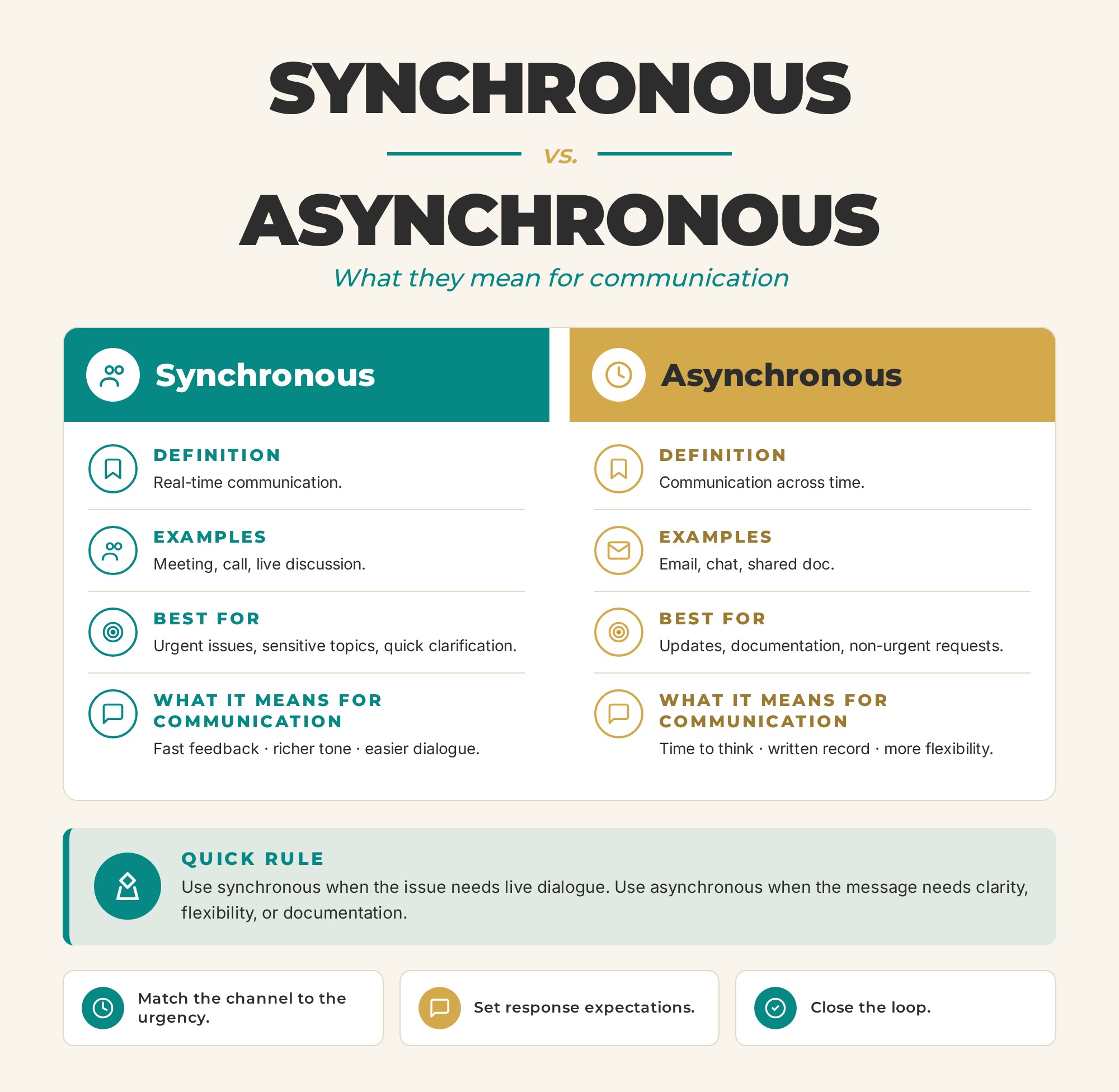
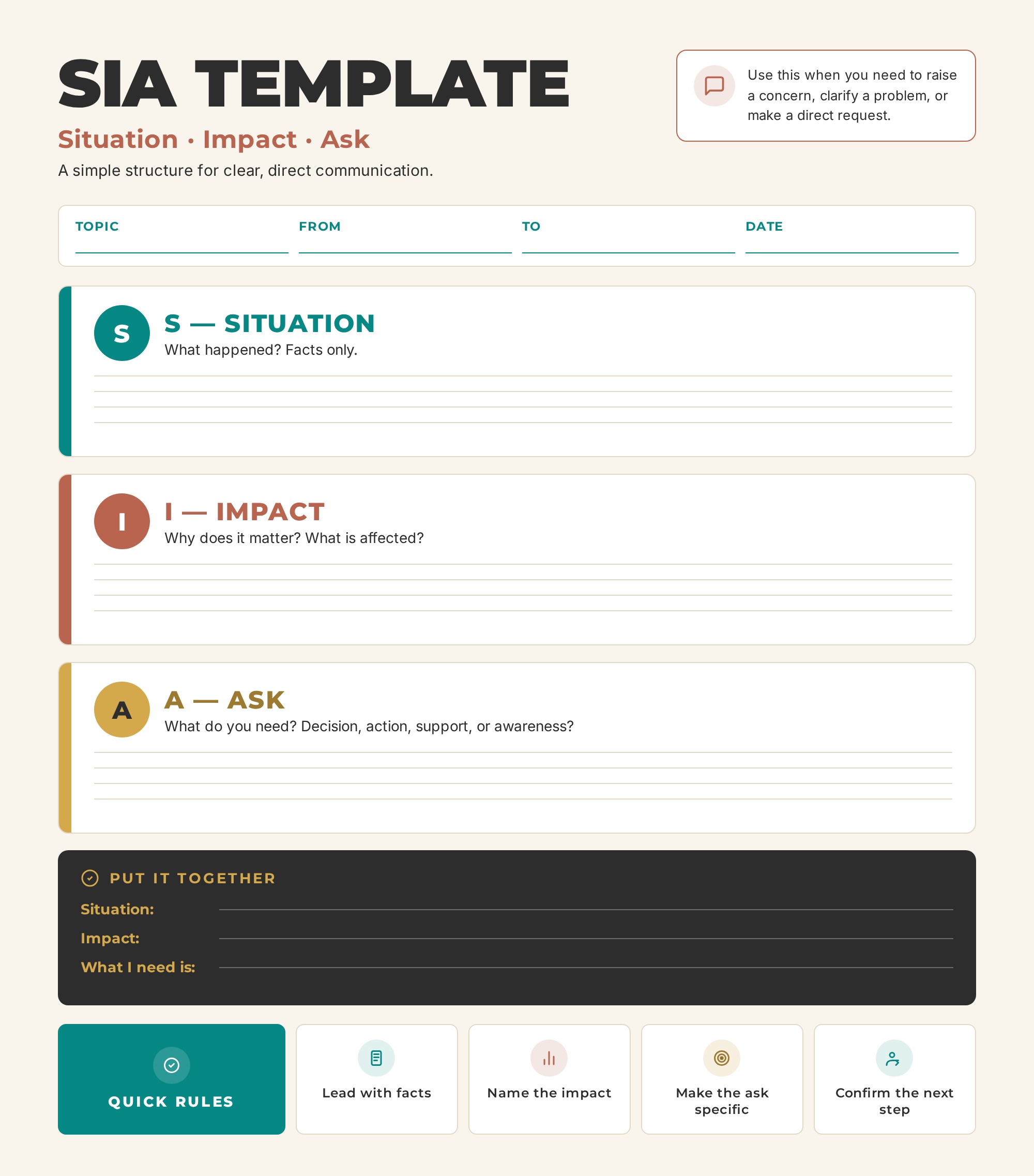
A short narrative from the floor — the moment a single phrase almost broke a message. The story behind the framework, before you read the diagrams.
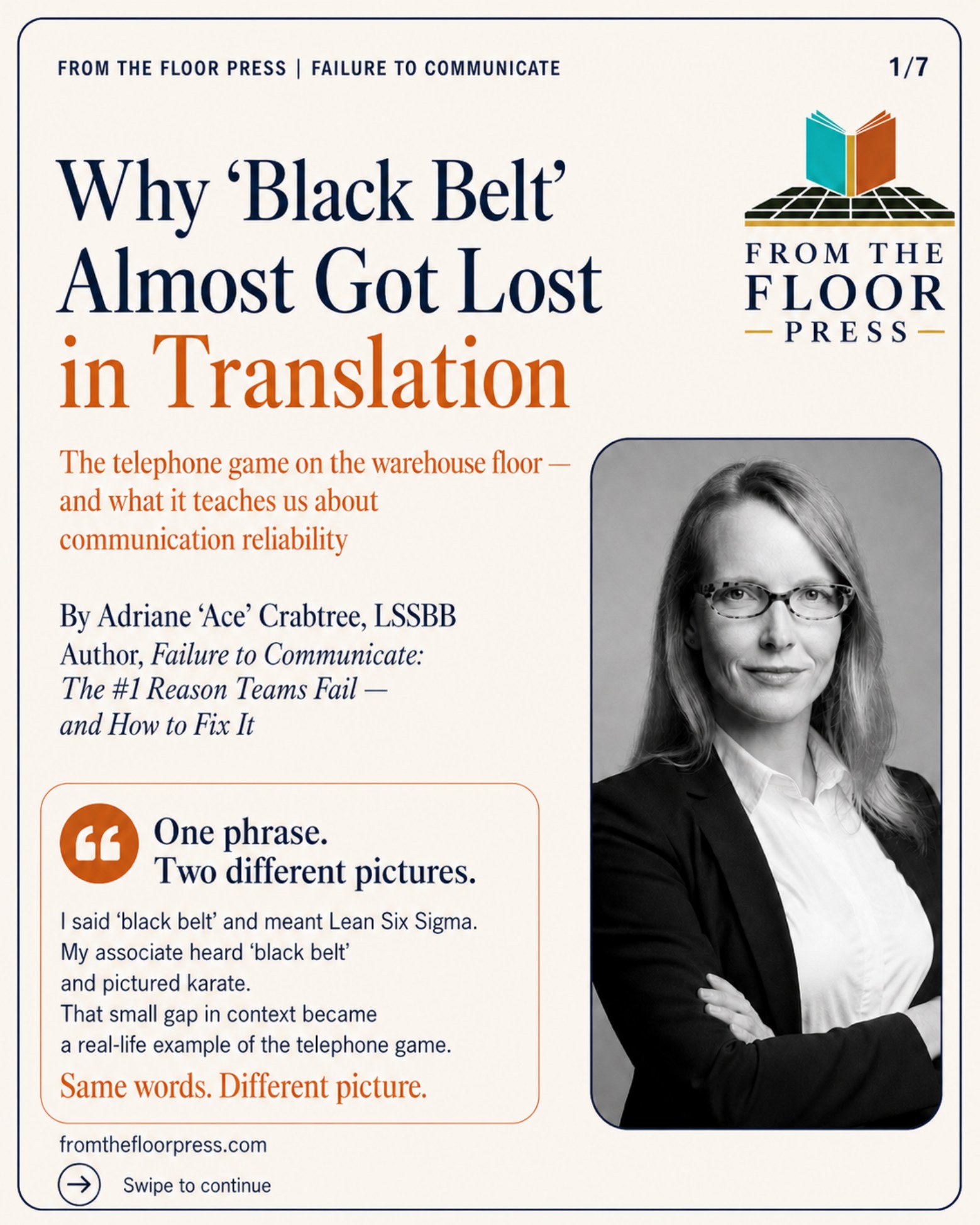
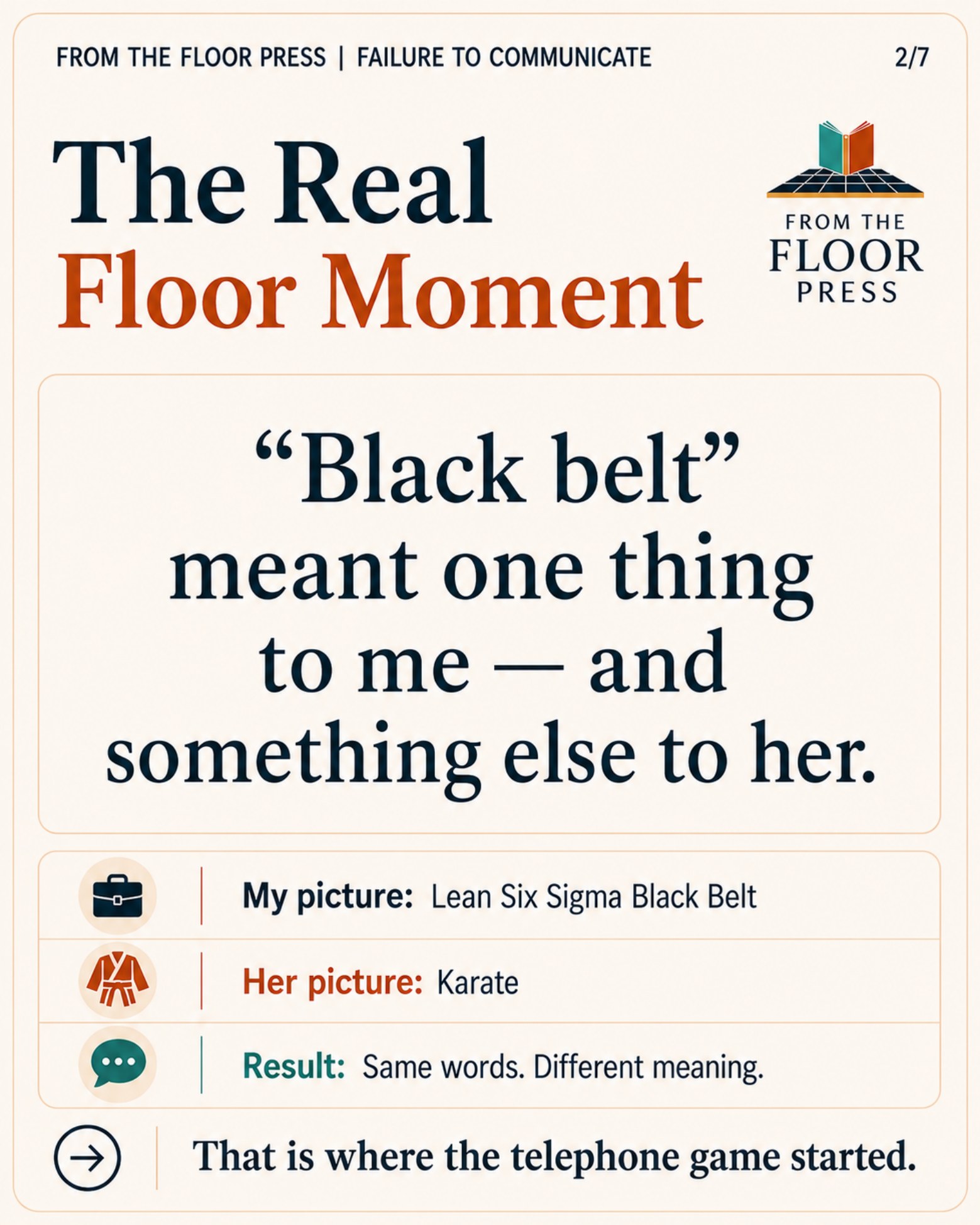
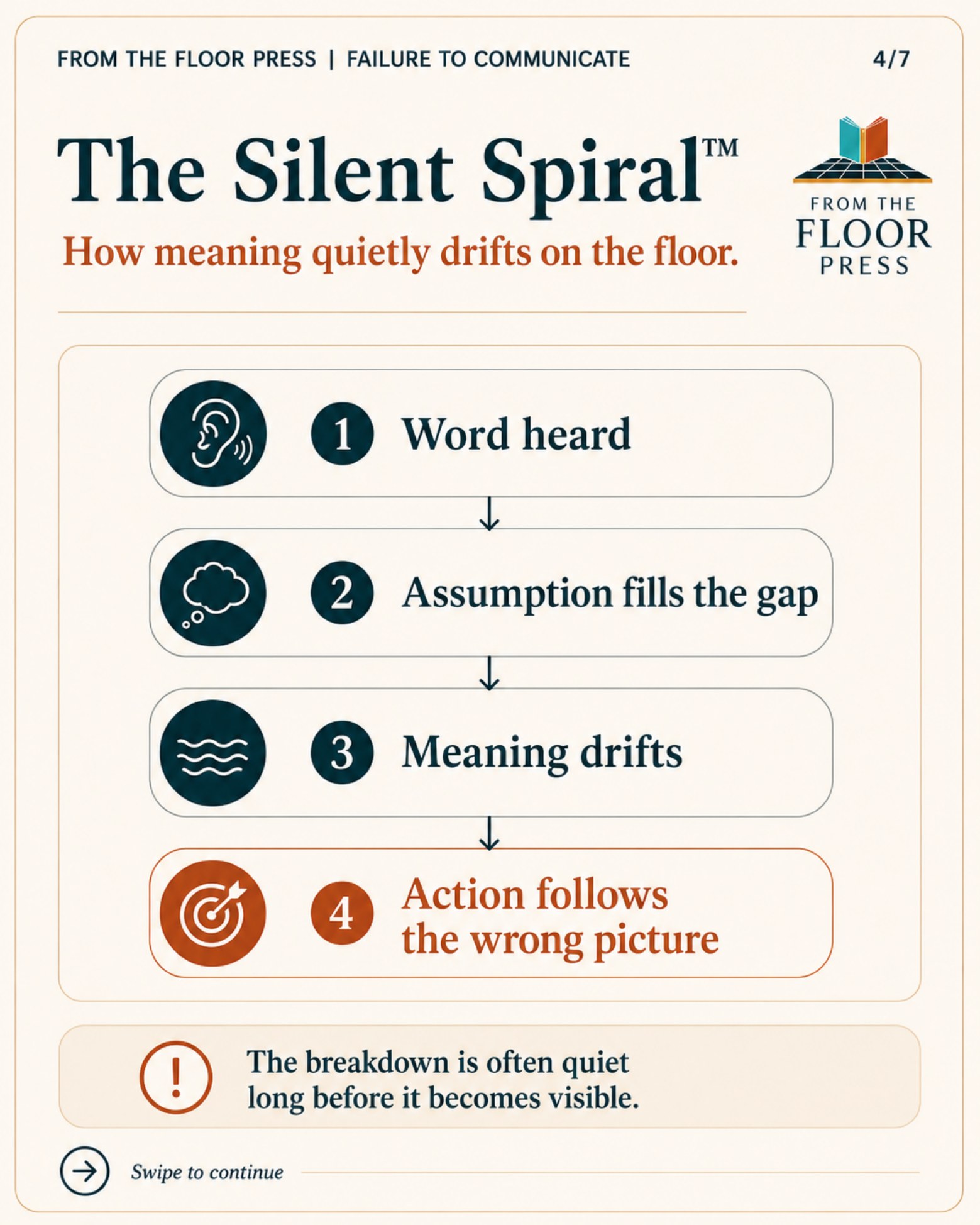
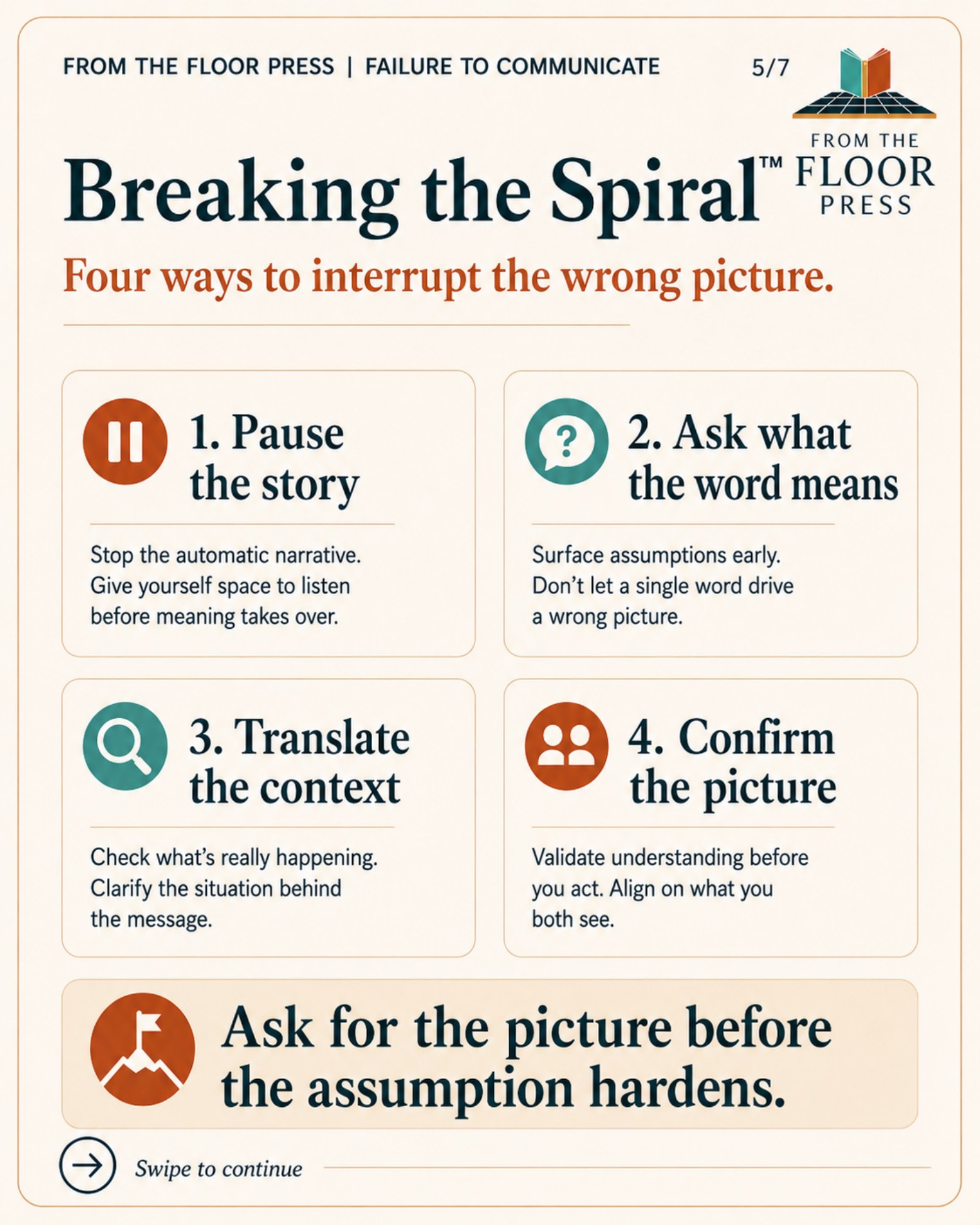
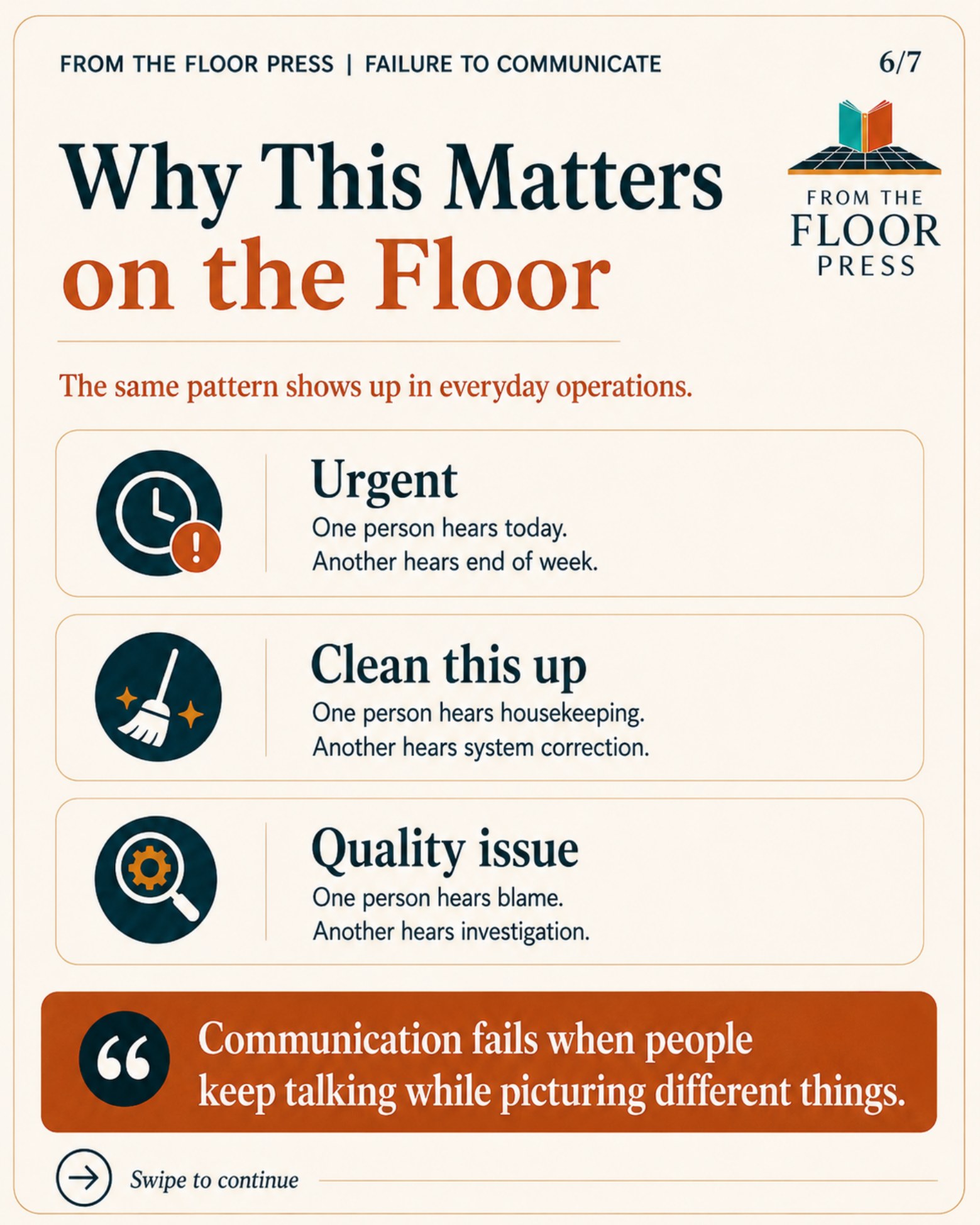
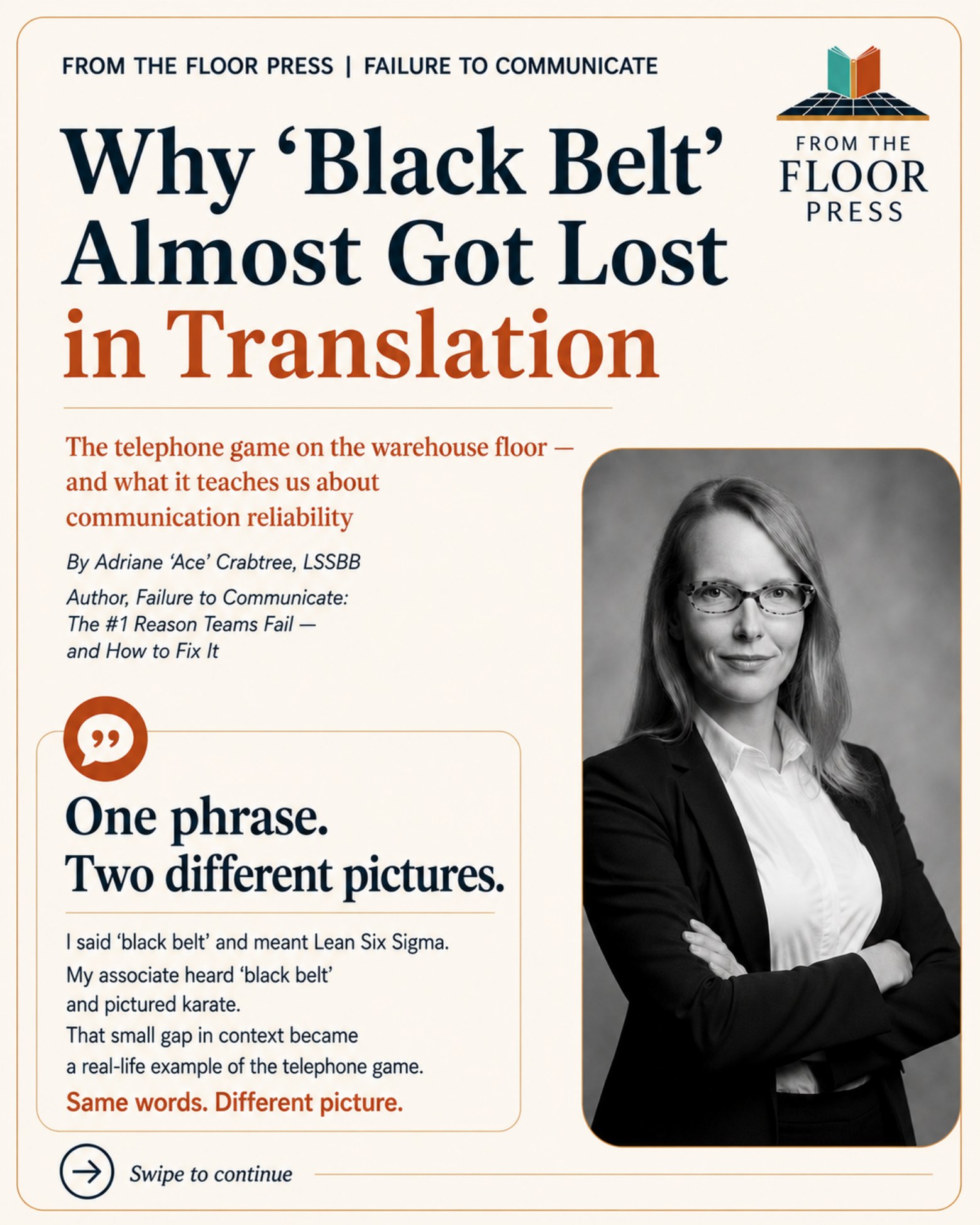
The opening. One phrase. Two different pictures. The story behind the framework.
Want the full set as a printable handout? Download the 7-page PDF.
Act 02 · The Frameworks
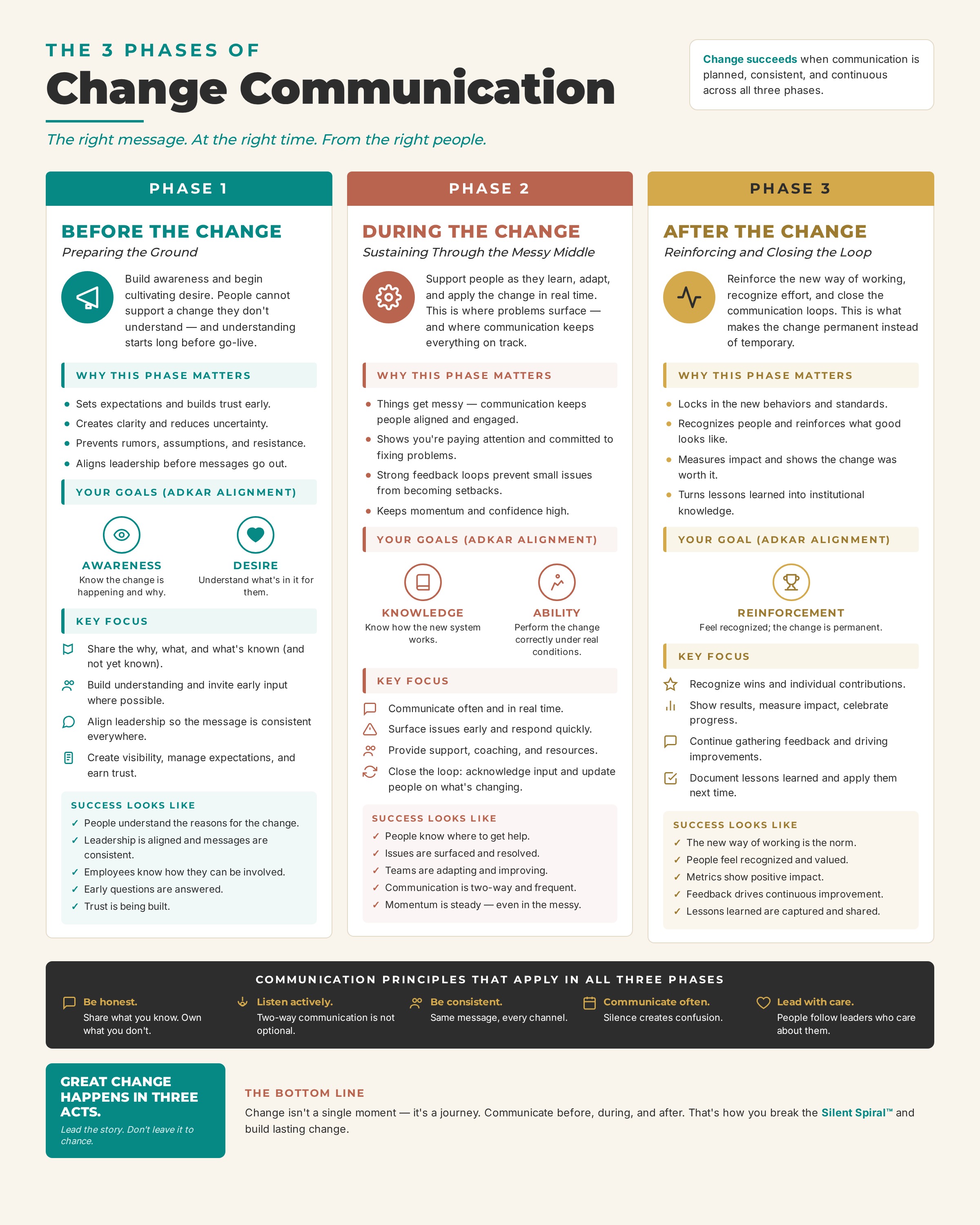
The paired diagnostic and playbook at the center of the book — plus three one-page references you can take into the meeting where the spiral is turning.
Every stage of the Silent Spiral™ has a direct antidote. The book walks through both, side by side, with stories from the floor.
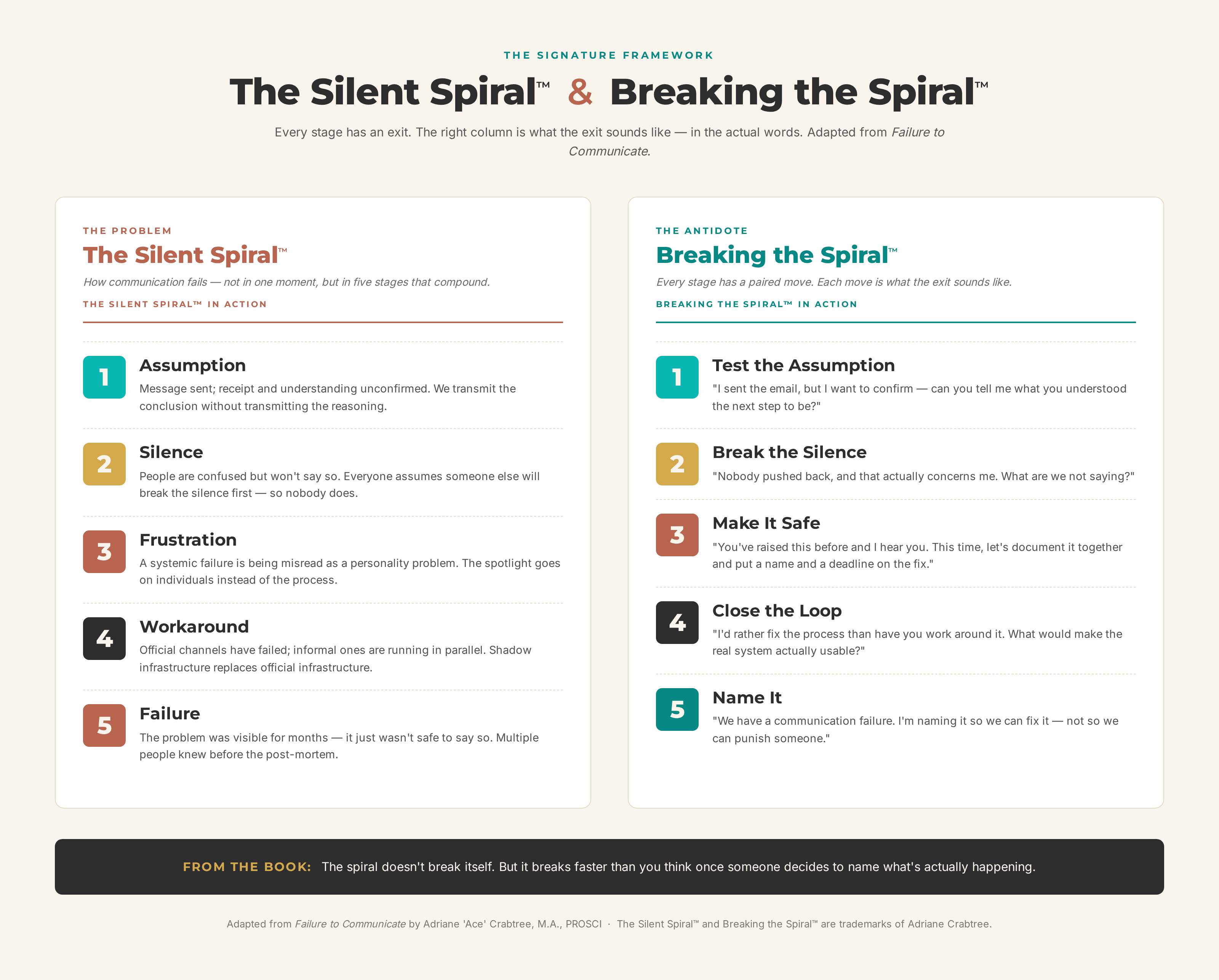
Four print-ready references built straight from the book. Use them in the meeting where the spiral is turning, not after.
Act 03 · The Practice
More titles in the domain, the bookable workshop, and the small-group activity book.
Communication Reliability is a multi-book domain. Failure to Communicate diagnoses the breakdown. The titles below pick up where it leaves off — with more in the imprint plan.
How to Build Trust, Clarity, and Accountability Before the Spiral Begins. The prevention-side companion — how to build a team culture where the Silent Spiral never gets started.
In editing.A standalone examination of fear as an organizational operating system — how it forms inside a team, what it costs the operation, and what it takes to dismantle.
A small-group activity book — not a workshop. For supervisors and team leads to run their own short, hands-on sessions on judgment, communication, and decision-making.
The frameworks travel. The workshop is bookable today. The activity book is in the imprint plan.
The Silent Spiral™ and Breaking the Spiral™ translated into a working session — built for leadership teams who need the language, not just the diagnosis. Scoped to your floor, shift pattern, and existing systems.
A Small-Group Activity Book for Sharper Thinking and Stronger Teams. Designed for supervisors and team leads to run their own short, hands-on sessions on judgment, communication, and decision-making.
Written from the floor and built to be used while the operation is running. Organized around The Five Moves™: Stabilize, Control, Build, Keep, Prepare — and delivered in three acts.
Act 01 · Read
The published work. Three pieces, in reading order: open the Guide, work through the Playbook, then go deeper one book at a time.
The front door to the whole library. Open it first — it introduces The Warehouse Standard™, names The Five Moves™, and shows you exactly how the Playbook and five Move books fit together. Written for someone meeting the work for the first time.
Inside: a working operations library at a glance, The Five Moves™ as one sequence, The Playbook as the umbrella, the five Move books as the depth, and how to run the program once you have it.
Free. No form. 12 pages. ISBN 979-8-9956659-1-5 assigned for the digital edition.
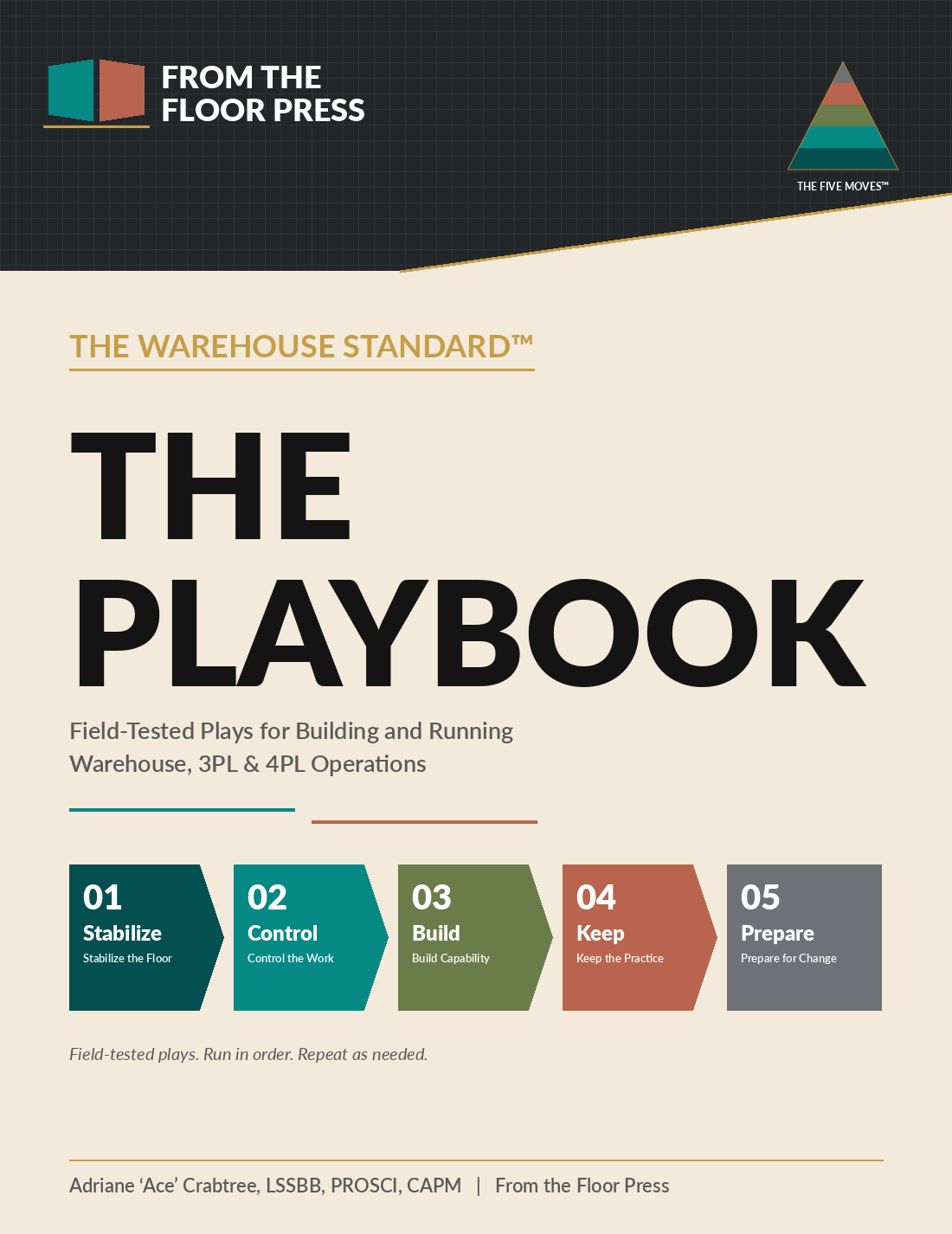
Field-Tested Plays for Building and Running Warehouse, 3PL & 4PL Ops. The front-door field guide into the operating philosophy — where The Five Moves™ are named, explained, and run as one progression. Opens with Set the Context — The Operating Model, followed by five sections labeled Move 1 through Move 5.
Inside the book · The Five Moves™
Five moves a real operator runs on the floor. You do not have to learn a model to use them — you just need to know which one you are working on right now. The Playbook walks the progression; each move opens a door to a deeper book in the Series.
Stabilize the Floor
The Floor
Control the Work
The Standard
Build Capability
The Bench
Keep the Practice
The Line
Prepare for Change
The Change
Walk the floor and ask one question: what keeps breaking that we already thought we fixed? The answer usually names your move.
Plays organized by the question you are actually asking, not by an academic taxonomy. Built to be opened mid-shift and acted on the same day.
Frameworks that hold up in a stand-up: CNX™ issue routing, the Triage Framework™, and the disciplines that turn fire-fighting into a repeatable system.
The named moves — detect, tag, triage, resolve, close the loop, improve — in language a supervisor can teach without a workshop.
Each book carries one of The Five Moves™ and answers the question an operations leader is actually asking at that move. Sequenced release rolling out through Q4 2026. The Playbook is where the move begins; the book is where it goes deeper.
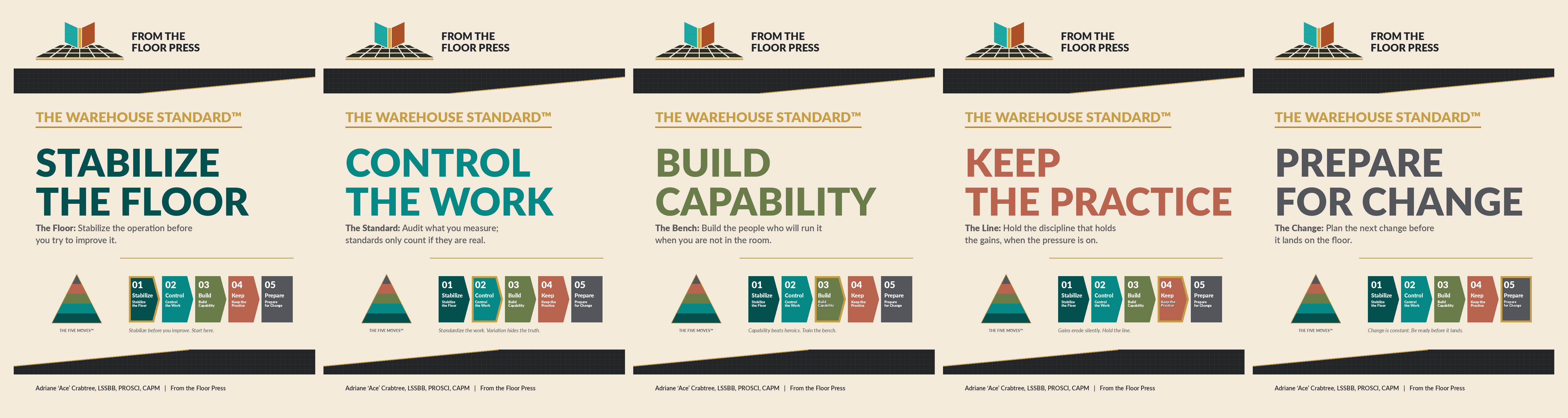
Tap any book to expand. Move 1 opens by default.
The Floor: Stabilize the operation before you try to improve it.
How do I make the floor stable, safe, and measurable day to day?
Get the basics steady so daily work holds under pressure. Find the gaps that cause repeat fires. The first move — a site cannot control, build, keep, or prepare if the floor is not stable. Anchors the End-to-End Warehouse Operations Framework™. Quality & Continuous Improvement is Toolkit 1, the move's primary set.
The Standard: Audit what you measure; standards only count if they are real.
How do I write, own, and verify SOPs — and close corrective action?
Make the work repeatable. Write down how things actually run. Make sure the operation behaves the same way across shifts and people. Home of Write → Validate → Train → Certify™ — the required pipeline before any document is treated as live standard work.
The Bench: Build the people who will run it when you are not in the room.
How do I train, qualify, cover, and coach without losing the standard?
Develop the people who run the floor. Set clear expectations. Meet training and compliance needs without slowing the operation down.
The Line: Hold the discipline that holds the gains, when the pressure is on.
How do I hold the gains when the pressure is on and no one is watching?
The hardest move. Gains erode silently if no one holds the line. Shift huddles that actually work, audit cadence that doesn't drift, leadership behaviors that hold the standard when pressure is on. Returns discipline lives here — the back-end of operational integrity. For mature sites trying not to slide.
The Change: Plan the next change before it lands on the floor.
How do I prepare for messy change without betting the operation on it?
Get ready for growth, new accounts, and shifting demand before the pressure hits. Home of Truth Before Transition™ — the System Truth Table, SOP Gap Analysis, Three-Gate Readiness, and Three-Proof Test.
Act 02 · Apply
The applied layer behind the books. Practical tools that hang off The Five Moves™ — toolkits, the field workbook, worksheet sets, and one-page field cards. Built first as the engine for workshops, consulting, certification cohorts, and in-house facilitation. Available ad hoc for anyone working a specific problem on the floor.
Scoped workshops, certification cohorts, and in-house facilitation use this layer to turn the books into practice. Built for site directors, ops leaders, and QA teams who need the work delivered on their floor.
Download a worksheet set or a one-page field card and put it to work today. No engagement required. The same tools your team would use inside a workshop, available ad hoc for the problem in front of you.
Four sub-bodies, all tied to The Five Moves™. Each one stands on its own and reinforces the others.
Practical templates, checklists, logs, trackers, and control tools for broad operating problems. The Twelve Toolkit Sets are numbered in Move order — Toolkit 1 through Toolkit 12 — each grouped under the move it carries.
Workbook extracts, templates, scorecards, and activation tools that turn the toolkits into reps. Built for site directors, supervisors, and QA leads to apply the work directly to their own operation — before any major activation, audit, transition, or recovery.
Drafted; in revision.
A worksheet set is the smallest publishable unit of useful work: one operating problem, a printable way to work it, and a record left behind. The low-commitment entry point into the library. The first set is built and in revision; five more are in drafting behind it.
Every set in the lane meets four tests before it ships: when to use it, what it helps decide, what it produces, what failure it prevents.
Errors enter the building at the dock door. This set takes custody: it captures dimensions and unit of measure, preserves evidence while the load is still on the dock, and turns each exception into a record the customer can act on.
Carries: Stabilize the floor · Control the work · Routes to Move 1, Move 2, T1, T7Free, printable, one-page operator tools. Each card teaches one discipline and gives the floor a way to run it without a workshop. More cards land here as they ship.
Workshops, certification cohorts, and in-house facilitation are scoped around the toolkit, the workbook, the worksheet sets, and the field cards you just saw. Tell us what's breaking and we will scope from there.
Act 03 · Practice
Before you reach for any of it: define the problem first. The quiet architecture that holds the whole library together.
A toolkit cannot solve a problem you have not defined. Before you reach for one, name what is happening, what should be happening, and what is in the way. Five lines. One page. If it does not fit on the page, you do not have a problem yet — you have a feeling.
Need the printable? It lives on the shelf in Act 02 · Field Cards.
Every download on this page is the work itself — not a teaser, not a lead magnet. They’re the field cards, worksheets, and frameworks Ace uses with operations teams, leadership rooms, and the people running the shift right now. Take what you need. Bring it to the huddle.
Three letter-size PDFs that name what’s breaking, show the stages it moves through, and give you the moves to interrupt it. Use them in the meeting where the spiral is turning, not after.
Two structured worksheets and a bonus chapter. Print them, fill them in, leave them on the desk of the person who needs them.
Two longer reads that orient you to the work, the language, and the architecture of The Warehouse Standard™. Start with the Core Library Guide if you’re new to the system.
When you’re ready for the complete frameworks, the chapter-by-chapter teaching, and the worksheet sets that go with them, the books are in the catalogue.

Two decades of operations and leadership experience across hospitals, education systems, government agencies, and high-volume 3PL and 4PL warehouse distribution. Lean Six Sigma Black Belt. Prosci-certified change practitioner. CAPM.
From the Floor Press exists to publish what gets written on the back of receiving sheets — the operational truth nobody at the corporate office wanted to print. Two domains, one editorial standard.
“If a passage couldn’t survive being read out loud at a 4:30 a.m. shift huddle, it gets rewritten.”
If your leaders need the Silent Spiral™ in their language, or your operations team needs The Warehouse Standard in workshop form — start here. Every engagement is scoped to your floor, your shift pattern, and the systems you already run.
Scoped working sessions for leadership teams and operators. The Silent Spiral™ and Breaking the Spiral™ translated into the language your floor already uses.
Targeted scoping for site directors, ops leaders, and QA teams. Bring in The Warehouse Standard™ as a working partner on a specific problem.
Multi-session programs that move a team through the five moves, the toolkit, and the field practice — with a record left behind.
Ace runs the session on your floor. You keep the work, the materials, and the language. Best for operations teams already mid-change.
Send the note and Ace will reply directly. No funnel. No drip campaign.
From the Floor Press is an independent publishing imprint of Adriane ‘Ace’ Crabtree. This page is the authoritative record of the imprint’s copyright, trademark claims, and citation guidance. It is reviewed each time a new work, framework, or workshop enters the catalogue.
© 2021–2026 Adriane ‘Ace’ Crabtree. All rights reserved.
All books, workbooks, toolkits, worksheet sets, frameworks, and supporting materials published by From the Floor Press are protected by United States copyright law and international treaty. No portion of any From the Floor Press work may be reproduced, distributed, or transmitted in any form or by any means — including photocopying, recording, or other electronic or mechanical methods — without prior written permission, except for brief quotations embodied in critical reviews and certain other noncommercial uses permitted by copyright law.
For permission requests, write to the imprint at info@fromthefloorpress.com.
The following marks are trademarks of Adriane Crabtree or From the Floor Press, used in commerce in connection with books, workshops, frameworks, and consulting services in the imprint’s two domains. Unauthorized use of these marks in commerce, or in a manner that creates confusion with the imprint’s works, is prohibited.
The Silent Spiral™ and Breaking the Spiral™ are trademarks of Adriane Crabtree, used in Failure to Communicate and in workshops derived from that book.
The Warehouse Standard™, The Core Library Guide™, The Playbook™, The Playbook Series™, The Field Workbook™, The Toolkit Library™, and Worksheet & Control Sets™ are trademarks of From the Floor Press, used on the Warehouse, 3PL & 4PL Ops shelf and in associated training programs.
The Five Moves™, Truth Before Transition™, The Triage Framework™, End-to-End Warehouse Operations Framework™, CNX Issue Resolution Framework™, and Write → Validate → Train → Certify™ are trademarks of From the Floor Press. These frameworks are used across both domains and are the named, teachable through-lines of the imprint.
You may refer to a From the Floor Press mark in editorial, academic, or critical writing without permission — for example, naming The Silent Spiral™ in a book review or citing The Five Moves™ in a training-program comparison — provided the reference is descriptive, accurate, and does not imply endorsement, partnership, or origin.
You may not use any From the Floor Press mark in the title or branding of a competing book, workshop, framework, certification, toolkit, or consulting offer, or in any way that would mislead a reader or buyer about the source of the work.
If you reference a From the Floor Press framework in a paper, presentation, training material, or article, the imprint asks that you use one of the citation forms below. Frameworks travel; correct attribution keeps them traveling honestly.
Crabtree, A. (2026). Failure to Communicate: The #1 Reason Teams Fail — and How to Fix It. Indianapolis: From the Floor Press. ISBN 979-8-9956659-0-8.
The Silent Spiral™ (Crabtree, From the Floor Press, 2026).
Crabtree, A. The Five Moves™. From the Floor Press, 2026. fromthefloorpress.com.
This page is the imprint’s public record of copyright and trademark claims. It is reviewed each time a new work, framework, or workshop enters the catalogue, and is the canonical source for the trademark roster that appears in the back matter of every From the Floor Press book.
Editorial note: This page documents the imprint’s position on its own marks. It is not legal advice. For licensing inquiries, framework usage rights beyond what is described above, or permission requests, write to info@fromthefloorpress.com.